Skip to Content

My PhD: how forest structure influences arthropods in the Azores

I am investigating how changes in the structure of the Azores’ forests alter the distribution of arthropods, from the soil to the canopy, by linking biodiversity, microclimate and habitat complexity.


By combining long-term monitoring, field surveys, remote sensing and predictive modelling, my PhD research aims to better understand and anticipate the effects of forest changes on island biodiversity.

Forests are complex ecosystems that are essential for maintaining biodiversity and regulating the climate.

However, when they are altered by biological invasions, changes in land use or changes to the landscape, their structure also changes, and with it the living conditions of the species that inhabit them.


As part of my PhD research, I am studying how these changes influence the distribution of arthropods in the forests of Terceira Island, in the Azores.

My work aims to link forest structure, microclimate, vertical stratification and community organisation in order to better understand the future of biodiversity in island landscapes.

Who am I?

PhD student in ecology at the University of the Azores

I am a PhD student at the University of the Azores, in the Faculty of Science and Technology.

My work is supervised by Professor Paulo A.V. Borges (University of the Azores, CE3C – IBBC) and Dr João Pinelo (AirCentre).


My research lies at the intersection of forest ecology, island biogeography, entomology, microclimate, remote sensing and predictive modelling. Through this interdisciplinary approach, I aim to gain a better understanding of how changes in the structure of forest habitats affect biodiversity—particularly that of arthropods—in the island ecosystems of the Azores.


My thesis topic

Why forests are essential

Forests are not merely collections of trees: they are living systems that are home to a significant proportion of the Earth’s biodiversity, store carbon, regulate the water cycle and help mitigate the effects of climate change. Their ecological importance is considerable, but not all forests function in the same way.


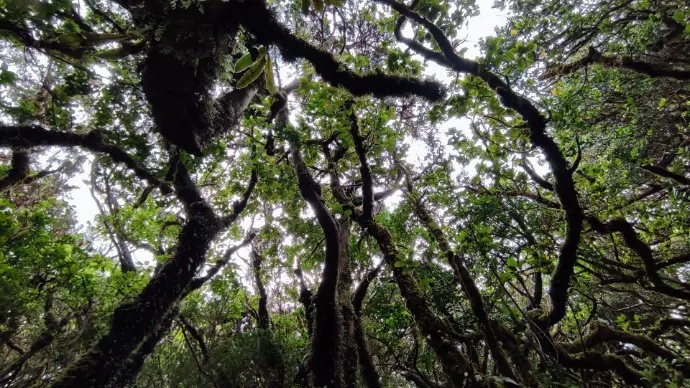
What sets them apart, beyond their floral composition, is also their structure: the height of the vegetation, the density of the canopy, the presence of multiple layers, and the diversity of microhabitats. This structure directly influences the environmental conditions within the forest, and therefore the species that can thrive there.


The structure of the home as a central theme

At the heart of my thesis lies a simple idea: the structure of a forest determines the biodiversity it supports. A complex forest often provides more refuges, resources and varied microclimatic conditions. Conversely, a simplified or altered forest can become more homogeneous and less favourable to certain species.


This issue is particularly important on a small scale. For many organisms, particularly arthropods, differences in temperature, humidity, light or vegetation between the ground, the undergrowth and the canopy can have a profound influence on how they are distributed across the landscape.


Why arthropods?

Arthropods are excellent models for studying the effects of environmental change. They are highly diverse, found in almost every part of the forest, and react quickly to changes in their habitat.


They also play fundamental ecological roles: breaking down organic matter, pollination, predation, nutrient recycling and shaping food webs. Studying their distribution therefore provides a better understanding of both the state of forest biodiversity and how ecosystems function.


The Azores as a natural laboratory

Islands are particularly valuable natural laboratories for ecology. Their isolation, high levels of endemism and vulnerability to disturbance make them ideal systems for studying how biodiversity responds to changes in its habitat.


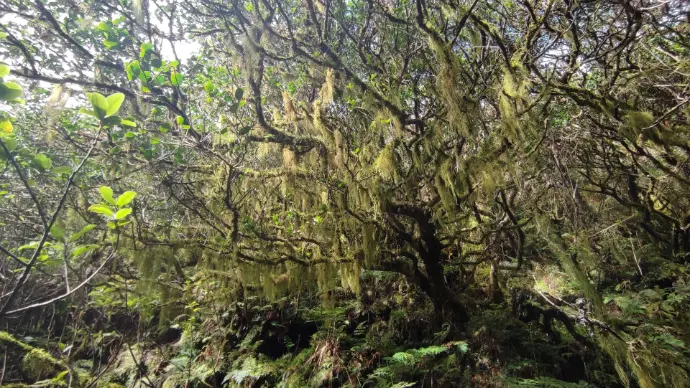
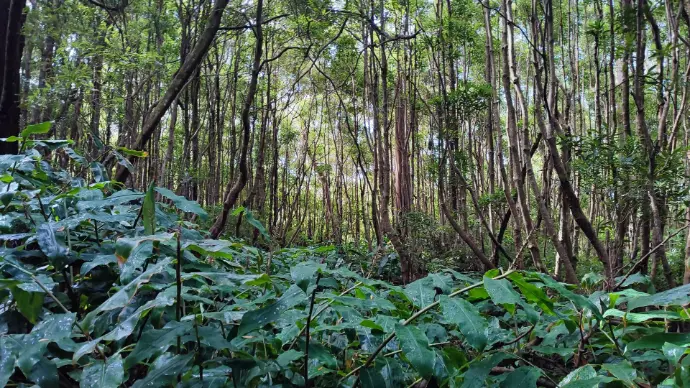
In the Azores, and more specifically on the island of Terceira, the native forests now survive in fragmented patches, set amidst landscapes that have been largely transformed. There is a stark contrast between the native high-altitude forests and the exotic secondary forests, which are often dominated by Pittosporum undulatum.

This contrast provides a unique opportunity to study how land-use history, biological invasions and changes in forest structure influence arthropod communities.


The overall aim of my thesis

The aim of my PhD is to understand how changes in forest structure influence the distribution, vertical stratification and ecological organisation of arthropod communities in the forests of the Azores.


To this end, I adopt an integrated approach that links several complementary dimensions: the physical structure of forests, the microclimate, species distribution, community composition, and the ecological relationships between organisms and habitats. This approach allows us to go beyond a simple comparison of environments and to explore the mechanisms linking habitat change and biodiversity responses. *** Translated with www.DeepL.com/Translator (free version) ***


From the ground to the canopy: a forest in three dimensions

A key aspect of my work is taking into account the vertical dimension of forests.

A forest is not a uniform environment: conditions vary greatly between the forest floor, the undergrowth, the shrubs and the taller parts of the vegetation. This vertical structure plays a major role in the distribution of arthropods.


My thesis therefore seeks to understand how species are distributed across these different strata, and how this stratification varies between native and exotic forests. This enables us to assess the extent to which transformed habitats retain — or fail to retain — some of the ecological complexity of native forests.


Innovative tools for studying forests

To analyse these issues, I use a range of complementary tools that enable me to study forests at different scales. LiDAR, drone imagery, remote sensing, vegetation surveys, microclimate measurements and predictive modelling approaches allow me to link habitat structure to biodiversity dynamics.


This methodological approach is one of the key strengths of my thesis. It enables me to describe the forest as a complex system—spatial, vertical and dynamic—and to explore the links between habitat and biodiversity in greater detail.


Predicting changes in biodiversity

Part of my research is based on long-term monitoring data on arthropods in the native forest of Terceira. These time series enable us to document changes in communities over the years and to gain a better understanding of the trends in the island’s biodiversity.


I am also exploring the potential of artificial intelligence and other forecasting methods to predict future changes in arthropod communities. This predictive aspect is important in the context of global change, as it helps us better understand how ecosystems might respond to the transformations currently taking place.


My thesis publications

Publications that form part of a coherent project

My thesis is structured around a series of complementary studies that explore different aspects of the same question: how changes in forest structure influence arthropod biodiversity in the forests of the Azores. These studies range from long-term monitoring to the analysis of habitat structure, including the vertical distribution of species and predictive modelling.


Each publication adds a piece to the jigsaw. Together, they help to build a comprehensive picture of the links between forest structure, microclimate and the organisation of arthropod communities.
Tracking changes over time

One aspect of my work focuses on the evolution of arthropod communities in the native forest of Terceira, based on data collected over the long term. ​

This approach provides a better understanding of the dynamics of change, the signs of decline, and the differences between native and non-native species.


Related publication:

Assessing the Impact of Insect Decline in Islands: Exploring the Diversity and Community Patterns of Indigenous and Non-Indigenous Arthropods in the Azores Native Forest over 10 Years.

Predicting ecological dynamics using artificial intelligence

Another focus of my thesis explores the use of artificial intelligence to predict the future composition of arthropod
communities.

The aim is to assess the extent to which these tools can help us better predict biodiversity responses based on ecological time series.


Related publication:

Artificial intelligence for biodiversity: Exploring the potential of recurrent neural networks in forecasting arthropod dynamics based on time series

Describe the structure of forests at various scales

My thesis also includes a section devoted to characterising the structure of native and exotic forests on the island of Terceira.
 ​

By combining LiDAR, drones, remote sensing and field surveys, this research provides a more detailed understanding of the complexity of forest habitats, from the landscape down to the microhabitat level.


Related publication:

Landscape to microhabitat: Uncovering the multiscale complexity of native and exotic forests on Terceira Island (Azores, Portugal)

To study the vertical distribution of arthropods

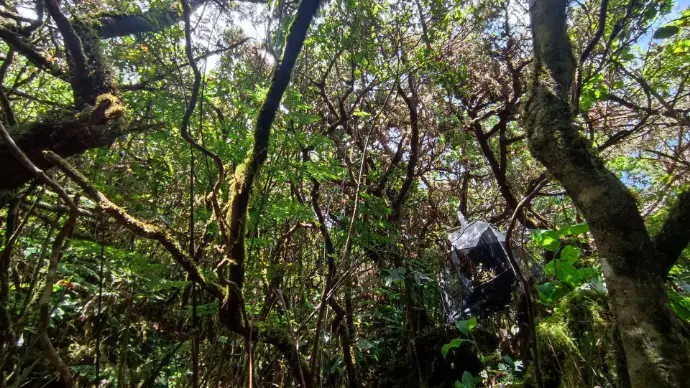
Another series of studies focuses on the distribution of arthropods across the different forest strata. 

This approach makes it possible to analyse how communities are organised vertically, and whether this organisation varies depending on the type of forest.


Related publication:

Vertical distribution of arthropod assemblages in native and exotic forests of Terceira Island (Azores, Portugal)

Understanding the similarity between communities from the soil to the canopy

Vertical stratification can also be studied by examining variations in composition between strata. ​

This study shows how the similarity between arthropod communities decreases with vertical distance, in both native and exotic forests.


Related publication:

Up from the bottom: Consistent vertical distance-decay in arthropod assemblage similarity across native and exotic forests in Terceira Island (Azores)


Exploring the role of exotic forests as a refuge

Another part of my thesis examines the unexpected presence of rare and endangered native species in exotic secondary forests on the island of Terceira. ​

In certain contexts, these transformed forests can also serve as refuges, suggesting that the traditional dichotomy between native and non-native habitats should be viewed with greater nuance in conservation thinking.


Related publication:

Beyond native habitats: Indigenous arthropods adapted to mid-elevations find refuge in exotic forests

Analysing the associations between arthropods and forest strata

Finally, a further area of research focuses on the interactions between arthropods and the various layers of native and exotic forests.


This approach enables us to investigate how taxonomic and functional diversity is distributed vertically, and to gain a better understanding of the links between community organisation and habitat structure.


Related publication:

Association networks of arthropods and forest strata in native and exotic forests


Understanding the vertical stratification of the microclimate

My thesis also examines how forest structure influences vertical variations in the microclimate within forests.


By combining microclimatic sensors and remote sensing data, this study establishes a direct link between the structural complexity of forests and the abiotic conditions to which arthropods are exposed at different forest layers.


Related publication:

Forest Structural Complexity Regulates Vertical Microclimatic Stratification


Why is this work important?

Bridging fundamental ecology and tools for the future

This thesis lies at the intersection of fundamental ecology and innovative methods. By combining field monitoring, detailed habitat characterisation, microclimatic measurements and predictive tools, it offers a more integrated understanding of how island forests function.


Beyond the scientific findings, this work also demonstrates how new technologies can help us to better observe, understand and anticipate changes in biodiversity. It is this integration of fieldwork, ecological analysis and methodological innovation that underpins my entire doctoral project.​

A better understanding leads to better conservation

The native forests of the Azores are home to a unique biodiversity, including many endemic species. However, these ecosystems are under significant pressure from biological invasions, landscape changes and environmental shifts.


My work aims to better identify the forest conditions that support the survival of native species and the persistence of diverse communities. It also helps us to better understand the role that exotic forests can play, in certain cases, within landscapes that have already been transformed. This knowledge is important for guiding management and conservation strategies tailored to the island context. *** Translated with www.DeepL.com/Translator (free version) ***


This PhD project is funded by the Fundo Regional da Ciência e Tecnologia as part of grant M3.1.a/F/012/2022.